How to Scale a Coaching Business by Building a Team: The Delegation Framework That Breaks the Revenue Ceiling
Solo coaching has a hard revenue ceiling — and most coaches hit it without realizing why. This delegation framework shows you how to build a lean support team that multiplies your capacity without multiplying your hours.
<h1>How to Scale a Coaching Business by Building a Team: The Delegation Framework That Breaks the Revenue Ceiling</h1>
<p>There's a moment every successful coach hits — usually somewhere between $8K and $15K per month — where growth suddenly stops feeling exciting and starts feeling suffocating. Your calendar is full. Your inbox is overflowing. You're doing everything: coaching, content creation, client onboarding, invoicing, social media, email marketing, and somehow still trying to have a life.</p>
<p>This is the <strong>solo coach revenue ceiling</strong>, and it's not a strategy problem. It's a capacity problem. You can't scale what only you can do.</p>
<p>The coaches who break through this ceiling don't work harder. They build smarter. They create systems, hire strategically, and delegate ruthlessly — and in doing so, they unlock the next level of growth that was always waiting on the other side of "I'll just do it myself."</p>
<p>This guide gives you the exact delegation framework to scale your coaching business beyond what any solo operator can achieve.</p>
<h2>Why Most Coaches Struggle to Delegate</h2>
<p>Before we get into the framework, let's name the real obstacles. Most coaches resist building a team for three reasons:</p>
<ul>
<li><strong>"No one can do it as well as I can"</strong> — This is true for your coaching. It's almost never true for your admin, content repurposing, or client scheduling.</li>
<li><strong>"I can't afford to hire"</strong> — This is usually backwards. You can't afford NOT to hire, because the hours you're spending on low-value tasks are preventing you from doing the high-value work that generates revenue.</li>
<li><strong>"I don't know what to delegate or how"</strong> — This is the real problem, and it's exactly what this framework solves.</li>
</ul>
<h2>The Delegation Audit: Finding Your Hidden Hours</h2>
<p>The first step is a simple but revealing exercise. For one week, track every task you do and assign it to one of three categories:</p>
<ul>
<li><strong>Zone of Genius:</strong> Tasks only you can do — coaching sessions, content creation, strategy, relationship building</li>
<li><strong>Zone of Competence:</strong> Tasks you're good at but others could do — email responses, social media scheduling, basic design</li>
<li><strong>Zone of Incompetence:</strong> Tasks you're not great at and shouldn't be doing — bookkeeping, tech setup, video editing</li>
</ul>
<p>Most coaches discover that 40-60% of their working hours are spent outside their Zone of Genius. That's the capacity you're going to reclaim.</p>
<blockquote>
<p><strong>The math is simple:</strong> If you bill at $200/hour and you're spending 15 hours per week on $15/hour tasks, you're losing $2,775 per week in opportunity cost. Hiring a VA at $20/hour for those tasks costs $300/week and frees you to generate $3,000 in additional revenue. That's a 10x return on your first hire.</p>
</blockquote>
<h2>The 4-Role Team Structure for Scaling Coaches</h2>
<p>You don't need a large team to break through the revenue ceiling. Most coaches who scale to $30K-$50K/month do it with a lean 4-role structure:</p>
<h3>Role 1: Virtual Assistant (VA) — Your First Hire</h3>
<p>Your VA handles the operational tasks that eat your time but don't require your expertise: inbox management, calendar scheduling, client onboarding logistics, invoice follow-ups, and basic research. Start with 10-15 hours per week. This single hire typically frees 8-12 hours of your time immediately.</p>
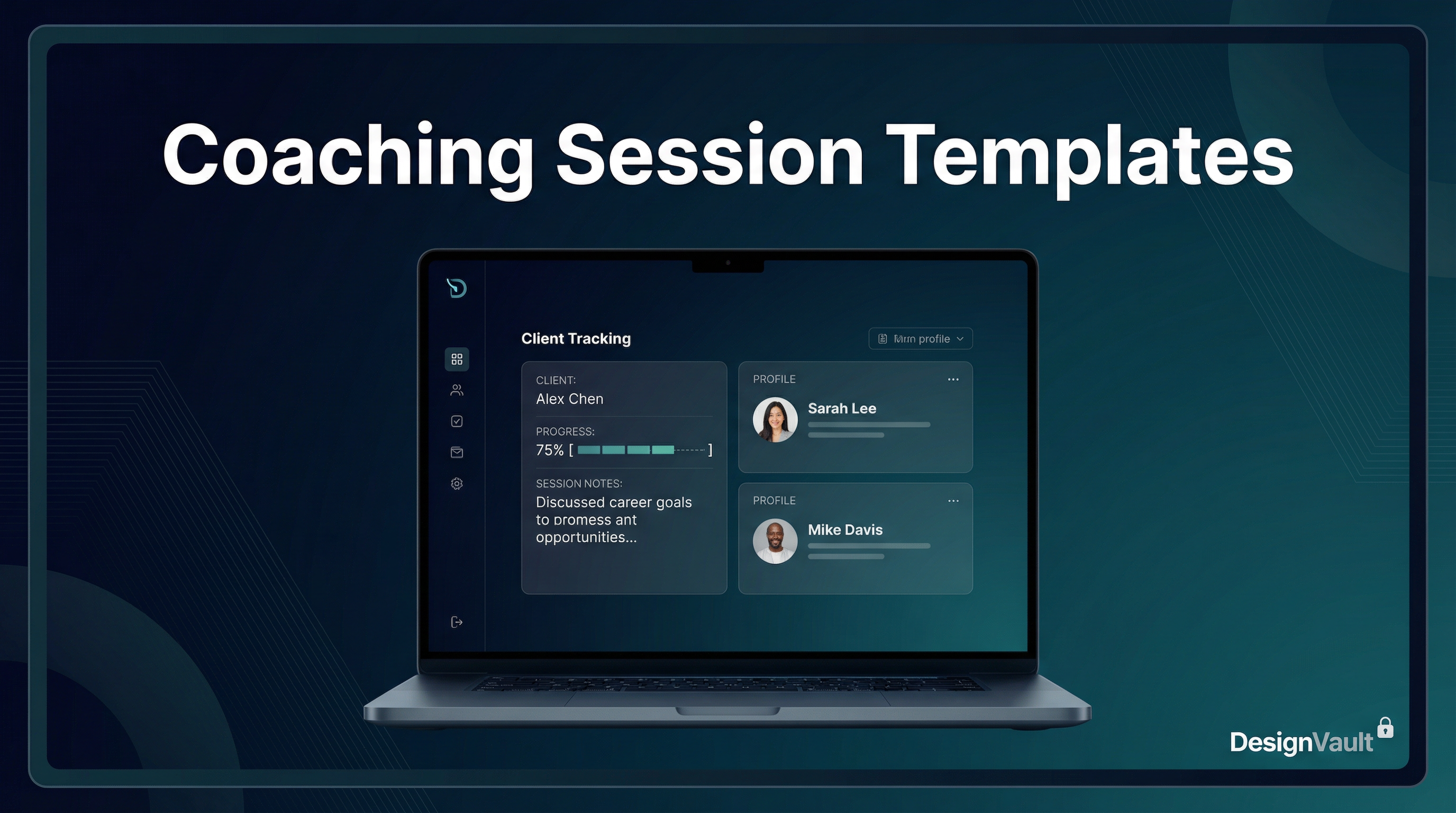
<p>Before you hire, document every process your VA will handle. The <a href="https://designvault.abacusai.app/products/coaching-session-templates">Coaching Session Templates and Client Tracker</a> includes client management workflows and onboarding checklists that make it easy to hand off these processes to a VA without losing quality or consistency.</p>
<h3>Role 2: Content Repurposer — Your Leverage Multiplier</h3>
<p>You create the core content — a podcast episode, a coaching session recording, a live training. Your content repurposer turns that one piece into 10: blog posts, social media clips, email newsletters, quote graphics, and YouTube descriptions. This role is typically part-time (5-10 hours/week) and can be filled by a skilled freelancer.</p>
<p>The <a href="https://designvault.abacusai.app/products/content-creator-social-media-toolkit">Content Creator Social Media Toolkit</a> gives your content repurposer the templates and frameworks they need to maintain your brand voice across every platform — without you having to review and rewrite everything they produce.</p>
<h3>Role 3: Client Success Manager — Your Retention Engine</h3>
<p>As your client roster grows, you need someone dedicated to the client experience between sessions: checking in on progress, answering questions in your community, celebrating wins, and flagging clients who might be at risk of dropping off. This role is critical for retention and referrals — two of the highest-leverage growth levers in coaching.</p>
<h3>Role 4: Launch Coordinator — Your Revenue Accelerator</h3>
<p>This role is project-based rather than ongoing. Your launch coordinator manages the logistics of every program launch: email sequences, landing pages, webinar tech, affiliate coordination, and post-launch analysis. Having a dedicated person for this means your launches actually happen on schedule — instead of getting pushed back because you're too busy coaching.</p>
<h2>The Delegation Framework: How to Hand Off Without Losing Control</h2>
<p>The biggest fear coaches have about delegation is losing quality. Here's the 4-step framework that eliminates that risk:</p>
<h3>Step 1: Document Before You Delegate</h3>
<p>Before handing off any task, record yourself doing it once (Loom works great for this). Write a simple SOP (Standard Operating Procedure) that covers: what the task is, when it needs to be done, what "done" looks like, and any non-negotiables. This takes 20-30 minutes per task and saves hours of back-and-forth later.</p>
<h3>Step 2: Delegate with Context, Not Just Instructions</h3>
<p>Don't just tell your team member what to do — tell them why it matters. When people understand the purpose behind a task, they make better decisions when edge cases arise. "Schedule client calls on Tuesdays and Thursdays" is an instruction. "Schedule client calls on Tuesdays and Thursdays because those are my peak energy days and I want to show up at my best for clients" is context that helps them handle exceptions intelligently.</p>
<h3>Step 3: Create a Review Rhythm, Not a Micromanagement Loop</h3>
<p>Set up a weekly 30-minute team sync (async works too — a shared Loom or voice note) where team members share what they completed, what's in progress, and any blockers. This gives you visibility without requiring you to check in constantly. Trust the system, not the surveillance.</p>
<h3>Step 4: Build Feedback Loops, Not Correction Cycles</h3>
<p>When something isn't done to your standard, resist the urge to just fix it yourself. Instead, update the SOP, record a quick Loom showing the correct approach, and have the team member redo it. This investment in training pays dividends for every future instance of that task.</p>
<h2>Automating What You Can't Delegate</h2>
<p>Some tasks don't need a human — they need a workflow. Before you hire for a role, ask: "Could this be automated?" Common coaching business tasks that are better automated than delegated:</p>
<ul>
<li>New subscriber welcome sequences</li>
<li>Session reminder emails and follow-up surveys</li>
<li>Invoice generation and payment reminders</li>
<li>Lead magnet delivery and nurture sequences</li>
<li>Social media scheduling from a content calendar</li>
</ul>
<p>The <a href="https://designvault.abacusai.app/products/complete-online-coach-business-kit">The Complete Online Coach Business Kit</a> includes automation templates and workflow systems specifically designed for coaching businesses — so you can automate the repetitive touchpoints and reserve your team's human capacity for the work that actually requires judgment and relationship. Use code <strong>COACH25</strong> for 25% off coaching products.</p>
<h2>The Hiring Timeline: When to Add Each Role</h2>
<p>Here's a practical roadmap for building your team as your revenue grows:</p>
<ul>
<li><strong>$5K-$10K/month:</strong> Hire a part-time VA (10 hrs/week). Focus on reclaiming your time for revenue-generating activities.</li>
<li><strong>$10K-$20K/month:</strong> Add a content repurposer. Start showing up consistently on more platforms without working more hours.</li>
<li><strong>$20K-$35K/month:</strong> Bring on a Client Success Manager. Your retention and referral rates will improve dramatically.</li>
<li><strong>$35K+/month:</strong> Add a Launch Coordinator. Your launches become predictable revenue events instead of chaotic sprints.</li>
</ul>
<h2>Measuring the ROI of Your Team</h2>
<p>Track these metrics monthly to ensure your team investment is paying off:</p>
<ul>
<li><strong>Hours reclaimed:</strong> How many hours per week are you no longer spending on delegated tasks?</li>
<li><strong>Revenue per coaching hour:</strong> Is your effective hourly rate increasing as you delegate lower-value work?</li>
<li><strong>Client retention rate:</strong> Are clients staying longer and referring more since you added team support?</li>
<li><strong>Launch revenue:</strong> Are your launches generating more revenue with less personal effort?</li>
</ul>
<h2>Your Next Step: Start With One Hire</h2>
<p>The coaches who stay stuck at the revenue ceiling are the ones who keep saying "I'll hire when I have more time to train someone" or "I'll delegate when I have more money." Both of those conditions are created by hiring, not prerequisites for it.</p>
<p>Start with one hire. Document three tasks. Hand them off. Reclaim those hours. Use them to generate more revenue. Then hire again.</p>
<p>The delegation framework isn't complicated. It just requires the decision to stop being the bottleneck in your own business — and the systems to make that transition smooth. Build those systems once, and they'll support your growth for years to come.</p>
Tools to Put This Into Practice
Skip the DIY — these templates are built for exactly what you just read about.