Email Marketing Automation for Coaches: Build a Nurture Funnel That Sells Your Programs on Autopilot
Learn how to build a high-converting email nurture funnel that automatically turns new subscribers into coaching clients — even while you sleep.
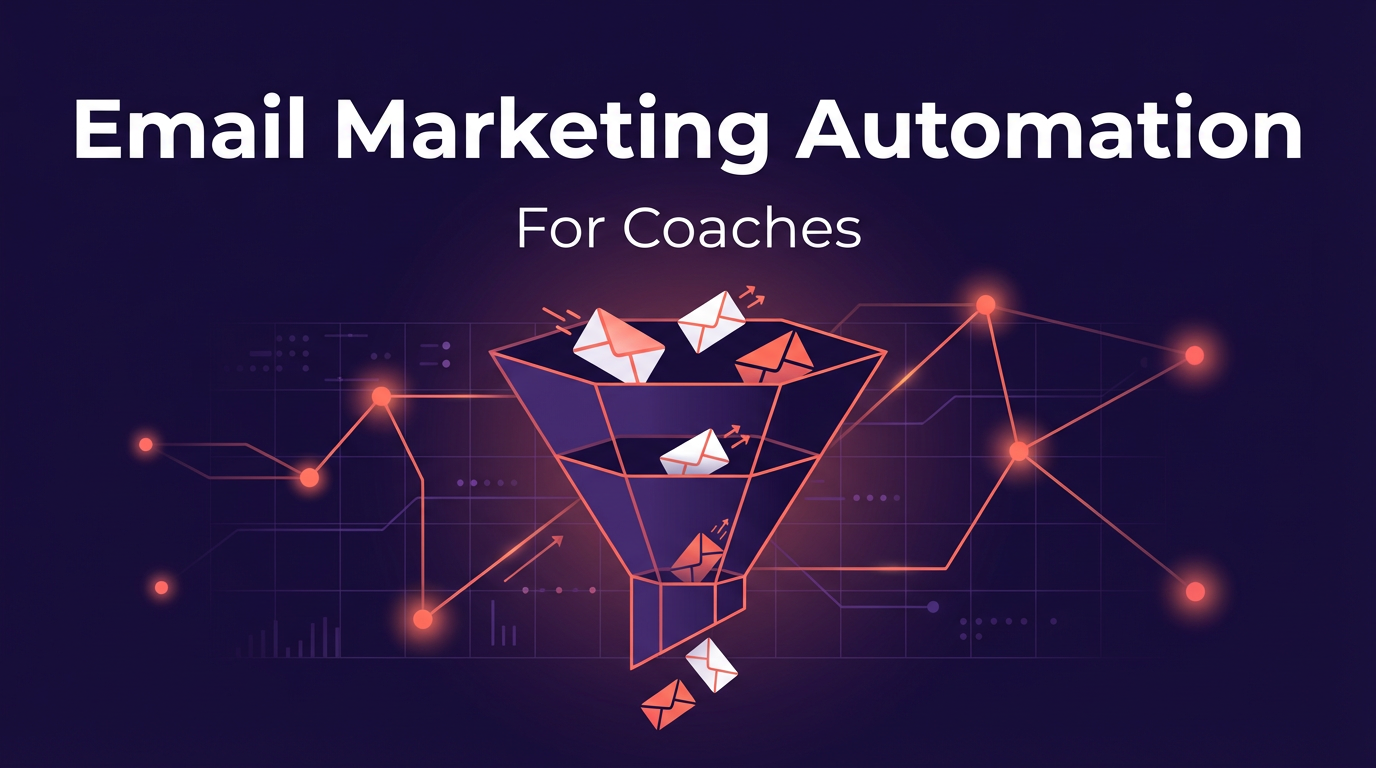
<h1>Email Marketing Automation for Coaches: Build a Nurture Funnel That Sells Your Programs on Autopilot</h1>
<p>You've heard it a thousand times: "The money is in the list." But if your email list isn't generating consistent coaching clients, the problem isn't the list — it's the system (or lack of one) behind it.</p>
<p>Most coaches send the occasional newsletter, maybe a promotional email when they launch a new program, and then wonder why their list isn't converting. The coaches who consistently fill their programs from email? They've built <strong>automated nurture funnels</strong> that work around the clock, building trust and moving subscribers toward a buying decision — without requiring daily manual effort.</p>
<p>In this guide, you'll learn exactly how to build an email marketing automation system that turns cold subscribers into warm, ready-to-buy coaching clients on autopilot.</p>
<h2>Why Most Coaching Email Lists Don't Convert</h2>
<p>Before we get into the how, let's diagnose the why. There are three main reasons coaching email lists underperform:</p>
<ul>
<li><strong>No welcome sequence:</strong> New subscribers get one welcome email and then silence until the next newsletter. By then, they've forgotten who you are.</li>
<li><strong>No nurture system:</strong> Emails are sent sporadically without a clear journey from "new subscriber" to "ready to buy."</li>
<li><strong>Selling too soon:</strong> Pitching programs before establishing trust and demonstrating value kills conversions and increases unsubscribes.</li>
</ul>
<p>The solution to all three is a properly structured automated email funnel.</p>
<h2>The 4-Stage Coaching Email Funnel Framework</h2>
<h3>Stage 1: The Welcome Sequence (Days 1–5)</h3>
<p>The welcome sequence is the most important part of your entire email funnel. New subscribers are at peak engagement — they just opted in, they're curious about you, and they're open to your message. This is your best window to make a strong first impression.</p>
<p>Your welcome sequence should accomplish four things:</p>
<ol>
<li>Deliver on the lead magnet promise immediately</li>
<li>Introduce yourself and your story in a relatable way</li>
<li>Establish your credibility and unique approach</li>
<li>Set expectations for what subscribers will receive from you</li>
</ol>
<p>A 5-email welcome sequence spread over 5 days works well for most coaches. Each email should be short (300–500 words), personal in tone, and end with a clear next step — whether that's reading a blog post, watching a video, or replying to a question.</p>
<blockquote><p><strong>Key insight:</strong> The welcome sequence isn't about selling. It's about building the relationship that makes selling easy later.</p></blockquote>
<h3>Stage 2: The Value Nurture Sequence (Weeks 2–6)</h3>
<p>After the welcome sequence, subscribers enter your ongoing nurture sequence. This is where most coaches drop the ball — they either stop emailing entirely or jump straight to promotional content.</p>
<p>The nurture sequence should deliver consistent, high-value content that addresses your ideal client's biggest pain points and positions you as the go-to expert. Aim for 1–2 emails per week during this phase.</p>
<p>Effective nurture email formats include:</p>
<ul>
<li><strong>Teaching emails:</strong> Share a specific framework, tip, or insight that helps subscribers make progress on their goals</li>
<li><strong>Story emails:</strong> Share client transformation stories (with permission) that illustrate what's possible</li>
<li><strong>Myth-busting emails:</strong> Challenge common misconceptions in your niche to differentiate your approach</li>
<li><strong>Behind-the-scenes emails:</strong> Give subscribers a peek into your process, philosophy, or daily practice</li>
</ul>
<p>The <a href="https://designvault.abacusai.app/products/email-marketing-swipe-file">Email Marketing Swipe File and Funnel Templates</a> includes done-for-you templates for all of these email types, making it easy to build out a full 6-week nurture sequence without staring at a blank page.</p>
<h3>Stage 3: The Conversion Sequence (Week 7–8)</h3>
<p>After 6 weeks of consistent value delivery, your subscribers know you, trust you, and have seen evidence that your approach works. Now it's time to make an offer.</p>
<p>The conversion sequence is a focused 7–10 day email series that introduces your coaching program, addresses objections, and creates urgency to act. Unlike a cold pitch, this sequence lands in a warm inbox — subscribers who've been receiving value from you for weeks are primed to say yes.</p>
<p>A high-converting conversion sequence typically includes:</p>
<ul>
<li><strong>Email 1:</strong> The transformation email — paint a vivid picture of what life looks like after working with you</li>
<li><strong>Email 2:</strong> The program introduction — what it is, who it's for, and what's included</li>
<li><strong>Email 3:</strong> Social proof — client results, testimonials, and case studies</li>
<li><strong>Email 4:</strong> FAQ and objection handling — address the top 3–5 reasons people hesitate</li>
<li><strong>Email 5:</strong> Urgency and deadline — enrollment closes, price increases, or bonuses expire</li>
<li><strong>Email 6:</strong> Last chance — final reminder with a clear, direct CTA</li>
</ul>
<h3>Stage 4: The Re-engagement and Evergreen Sequence</h3>
<p>Not everyone will buy during their first conversion sequence. That's normal. The key is having a system to re-engage non-buyers and continue nurturing them toward a future purchase.</p>
<p>After the conversion sequence, non-buyers return to a slower-paced evergreen nurture sequence — 1 email per week of continued value. Every 60–90 days, they'll enter another conversion sequence for the same or a different program.</p>
<p>This evergreen system means your email list is always working, always nurturing, and always converting — even when you're not actively launching.</p>
<h2>Setting Up Your Automation: The Technical Side</h2>
<p>The good news is that setting up this entire funnel doesn't require technical expertise. Most email marketing platforms (ConvertKit, ActiveCampaign, Mailchimp) have visual automation builders that make it straightforward.</p>
<p>The basic automation flow looks like this:</p>
<ol>
<li>Subscriber opts in via lead magnet — enters Welcome Sequence</li>
<li>Welcome Sequence completes — enters Nurture Sequence</li>
<li>After 6 weeks in Nurture — enters Conversion Sequence</li>
<li>Conversion Sequence completes (no purchase) — returns to Evergreen Nurture</li>
<li>Conversion Sequence completes (purchase) — moves to Client Onboarding sequence</li>
</ol>
<p>For coaches who want to take their automation further, tools like n8n can connect your email platform with your CRM, calendar, and payment processor to create a fully integrated client acquisition system.</p>
<h2>Your Lead Magnet: The Funnel Entry Point</h2>
<p>Your entire email funnel is only as good as your lead magnet — the free resource that gets people onto your list in the first place. A weak lead magnet means a slow-growing list and a funnel that never reaches critical mass.</p>
<p>The best coaching lead magnets solve a specific, immediate problem for your ideal client. Think: a quick-win checklist, a mini-training, a template, or a short guide that delivers real value in under 30 minutes.</p>
<p>The <a href="https://designvault.abacusai.app/products/lead-magnet-landing-page-templates">Lead Magnet and Landing Page Template Kit</a> includes high-converting templates for creating and promoting your lead magnet, including landing page designs that consistently convert at 30–50%.</p>
<h2>Measuring What Matters</h2>
<p>Once your funnel is live, track these key metrics weekly:</p>
<ul>
<li><strong>Open rate:</strong> Aim for 30%+ for a healthy, engaged list</li>
<li><strong>Click rate:</strong> 3–5% is solid; above 5% is excellent</li>
<li><strong>Conversion rate:</strong> Track how many subscribers become clients over 90-day windows</li>
<li><strong>Revenue per subscriber:</strong> Divide total email-attributed revenue by list size to benchmark performance</li>
</ul>
<h2>Build Your Funnel Once, Profit for Years</h2>
<p>The beauty of an automated email funnel is that you build it once and it works indefinitely. Every new subscriber who joins your list automatically goes through the same proven sequence that's already converted hundreds of others.</p>
<p>The <a href="https://designvault.abacusai.app/products/complete-online-coach-business-kit">Complete Online Coach Business Kit</a> includes a full email funnel template system alongside every other tool you need to run a profitable coaching business — from client onboarding to program delivery to marketing automation.</p>
<p>Use code <strong>COACH25</strong> for 25% off and start building your automated client acquisition system today. Your email list is one of your most valuable business assets — it's time to make it work as hard as you do.</p>
Tools to Put This Into Practice
Skip the DIY — these templates are built for exactly what you just read about.